QUICK ANSWER
The UGC NET Paper 1 syllabus (General Paper on Teaching and Research Aptitude) has 10 units. The paper has 50 compulsory questions of 2 marks each (100 marks), usually about 5 questions per unit, with no negative marking. The syllabus is the same for every subject and for UGC NET, JRF and SET.
📘 हिंदी में पढ़ें: UGC NET Paper 1 Syllabus in Hindi
If you are preparing for the NTA UGC NET, JRF or a State Eligibility Test, Paper 1 is the one paper every candidate writes, whatever the subject. A clear grip on its syllabus is the fastest way to secure up to 100 marks, because the questions come from a fixed and fairly small set of topics. This guide gives the complete UGC NET Paper 1 syllabus 2026 (also searched as the UGC NET first paper syllabus, 1st paper syllabus or Paper I / General Paper syllabus) unit by unit, the exam pattern, the usual weightage, an 8-week preparation plan, a printable checklist and 16 practice MCQs.
In this article
- What is UGC NET Paper 1?
- Is There a New Syllabus in 2026?
- UGC NET Paper 1 Exam Pattern 2026
- Syllabus at a Glance: 10 Units
- Unit-wise Detailed Syllabus
- Topic-wise Weightage & Scoring Units
- Same Syllabus for All Subjects, JRF and SET?
- Syllabus PDF Download
- How to Prepare: 8-Week Plan
- Syllabus Checklist
- Practice MCQs
- FAQs
What is UGC NET Paper 1?
UGC NET Paper 1 is the General Paper on Teaching and Research Aptitude. It is conducted by the National Testing Agency (NTA) along with Paper 2 (your subject paper) in the same computer-based test. Paper 1 checks whether a candidate has the basic aptitude to teach and do research at the university level: teaching and research skills, reasoning, comprehension, communication, data handling, ICT awareness, environment awareness and knowledge of the higher education system.
Because Paper 1 is common for all subjects, it is often the deciding factor in the final merit. A good score here can make up for a few weak questions in Paper 2.
Is There a New Syllabus for UGC NET Paper 1 in 2026?
No new syllabus has been introduced for the 2026 cycles. The present UGC NET Paper 1 syllabus, often called the new syllabus because it was revised from the June 2019 exam, is still the latest syllabus. It has the same 10 units for the June and December cycles, so the UGC NET 1st paper syllabus you study now is valid for 2026. If NTA ever revises it, the change is announced in the information bulletin on ugcnet.nta.ac.in.
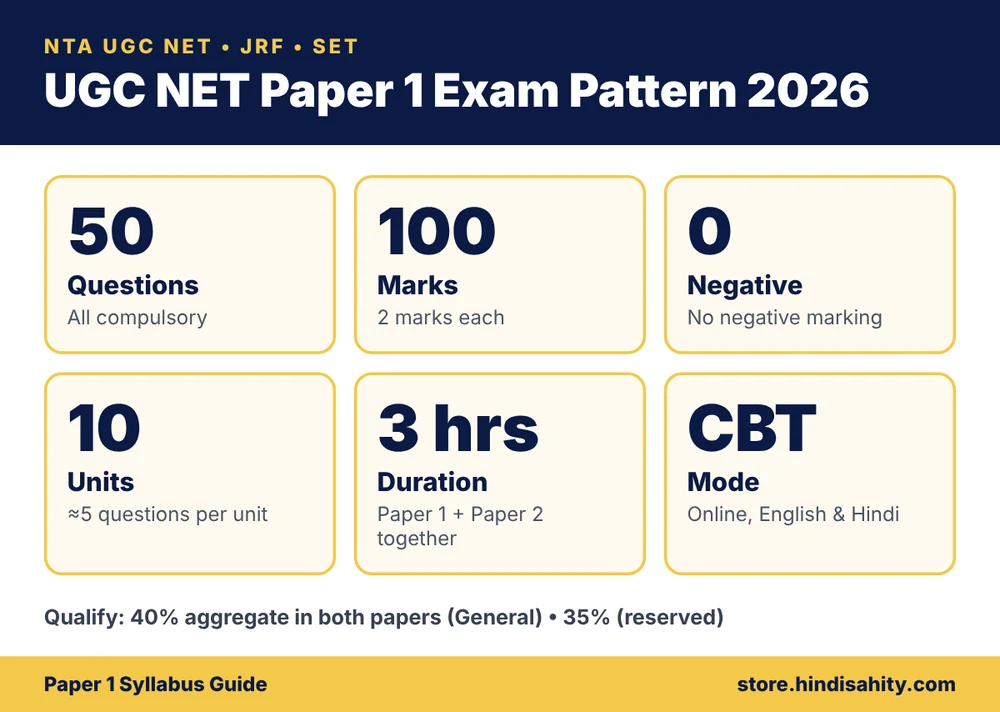
UGC NET Paper 1 Exam Pattern 2026
| Feature | UGC NET Paper 1 |
|---|---|
| Conducting body | National Testing Agency (NTA) |
| Mode | Computer-Based Test (CBT) |
| Questions | 50 multiple-choice questions, all compulsory |
| Marks | 100 (2 marks for each correct answer) |
| Negative marking | None |
| Duration | 3 hours for Paper 1 and Paper 2 together, without a break |
| Units | 10 (usually about 5 questions from each unit) |
| Medium | English and Hindi |
| Minimum aggregate to qualify | 40% in Paper 1 and Paper 2 together (General); 35% (reserved categories) |
December 2026 cycle: as per NTA’s revised calendar, UGC NET December 2026 is scheduled for 14–18 and 21 December 2026. Check the city slip, admit card and shift details on the official website ugcnet.nta.ac.in.
UGC NET Paper 1 Syllabus at a Glance: 10 Units
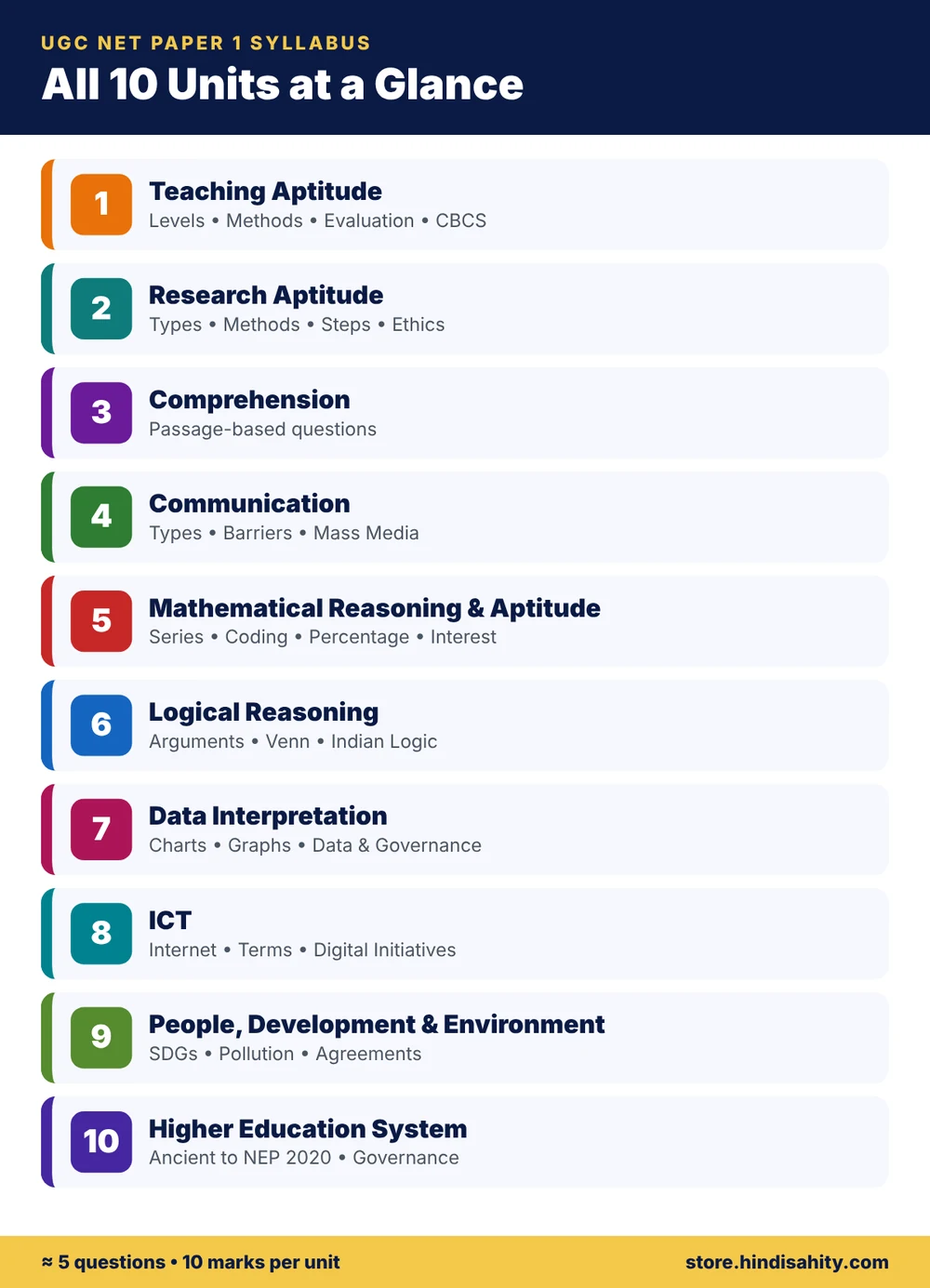
Here is the complete UGC NET paper first syllabus in one table, with the number of questions usually asked from each unit:
| Unit | Name of the unit | Usual questions | Marks |
|---|---|---|---|
| 1 | Teaching Aptitude | ≈ 5 | ≈ 10 |
| 2 | Research Aptitude | ≈ 5 | ≈ 10 |
| 3 | Comprehension | ≈ 5 | ≈ 10 |
| 4 | Communication | ≈ 5 | ≈ 10 |
| 5 | Mathematical Reasoning and Aptitude | ≈ 5 | ≈ 10 |
| 6 | Logical Reasoning | ≈ 5 | ≈ 10 |
| 7 | Data Interpretation | ≈ 5 | ≈ 10 |
| 8 | Information and Communication Technology (ICT) | ≈ 5 | ≈ 10 |
| 9 | People, Development and Environment | ≈ 5 | ≈ 10 |
| 10 | Higher Education System | ≈ 5 | ≈ 10 |
Unit-wise UGC NET Paper 1 Syllabus (Detailed)
Below is the complete official syllabus of each unit in simple words, followed by the topics from which questions are asked most often.
Unit 1: Teaching Aptitude
- Teaching: concept, objectives, levels of teaching (memory, understanding and reflective), characteristics and basic requirements
- Learner’s characteristics: characteristics of adolescent and adult learners (academic, social, emotional and cognitive); individual differences
- Factors affecting teaching: teacher, learner, support material, instructional facilities, learning environment and institution
- Methods of teaching in institutions of higher learning: teacher-centred vs. learner-centred methods; offline vs. online methods (SWAYAM, SWAYAM Prabha, MOOCs, etc.)
- Teaching support system: traditional, modern and ICT-based
- Evaluation systems: elements and types of evaluation; evaluation in the Choice Based Credit System (CBCS) in higher education; computer-based testing; innovations in evaluation systems
⭐ Most-asked topics: levels of teaching (Morrison), Bloom’s taxonomy, formative vs. summative evaluation, CBCS/grading, MOOCs and SWAYAM.
Unit 2: Research Aptitude
- Research: meaning, types and characteristics; positivism and post-positivistic approaches to research
- Methods of research: experimental, descriptive, historical, qualitative and quantitative methods
- Steps of research
- Thesis and article writing: format and styles of referencing
- Application of ICT in research
- Research ethics
⭐ Most-asked topics: types of research, hypothesis, sampling, variables, referencing styles (APA/MLA), plagiarism and research ethics.
Unit 3: Comprehension
- A passage of text is given, and questions are asked from that passage.
- Questions usually test the main idea, inference, the author’s tone or attitude, the meaning of words in context, and the most suitable title.
⭐ Most-asked topics: central idea, inference, tone, assumption and the best title.
Unit 4: Communication
- Communication: meaning, types and characteristics of communication
- Effective communication: verbal and non-verbal, inter-cultural and group communication, classroom communication
- Barriers to effective communication
- Mass media and society
⭐ Most-asked topics: communication models (Shannon–Weaver, Berlo’s SMCR), barriers, non-verbal cues, classroom communication and mass media.
Unit 5: Mathematical Reasoning and Aptitude
- Types of reasoning
- Number series, letter series, codes and relationships
- Mathematical aptitude: fraction, time and distance, ratio, proportion and percentage, profit and loss, interest and discounting, averages, etc.
⭐ Most-asked topics: number series, coding–decoding, blood relations, percentage, profit and loss, simple and compound interest, averages.
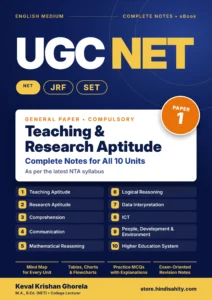
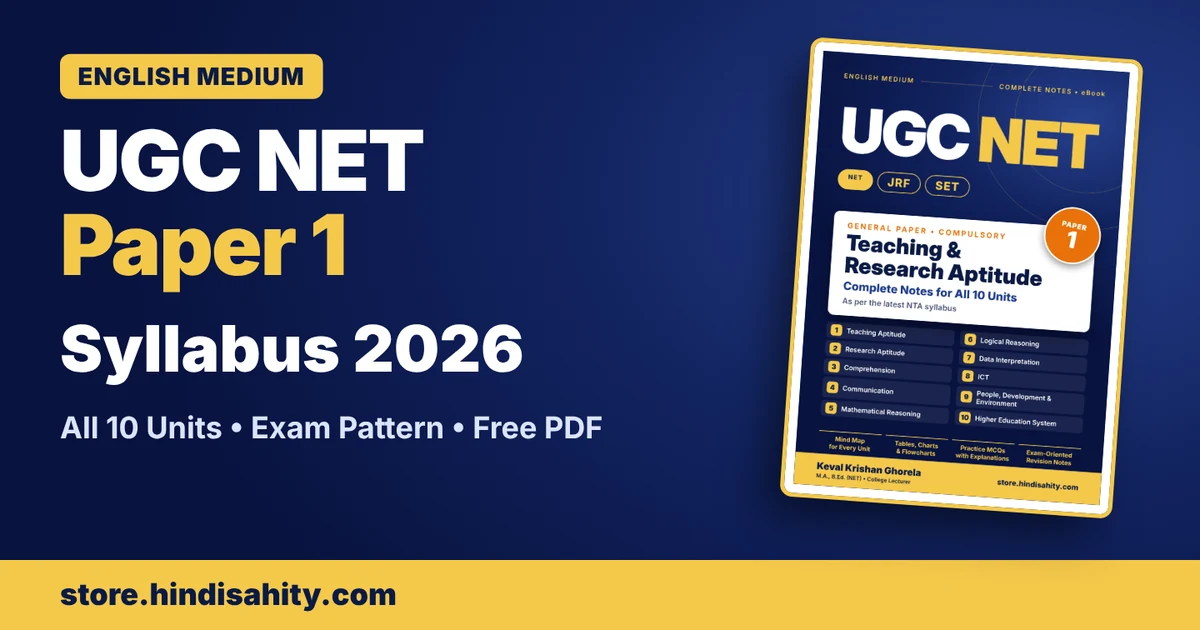
ENGLISH MEDIUM • 229-PAGE PDF
UGC NET Paper 1 Notes in English – All 10 Units
- Complete syllabus in short, clear notes with tables and flowcharts
- A mind map for every unit + 450+ practice MCQs with explanations
- Full-length 50-question mock test with answer key
Unit 6: Logical Reasoning
- Structure of arguments: argument forms, structure of categorical propositions, mood and figure, formal and informal fallacies, uses of language, connotations and denotations of terms, classical square of opposition
- Evaluating and distinguishing deductive and inductive reasoning
- Analogies
- Venn diagram: simple and multiple use for establishing the validity of arguments
- Indian logic – means of knowledge: Pramanas – Pratyaksha (perception), Anumana (inference), Upamana (comparison), Shabda (verbal testimony), Arthapatti (implication) and Anupalabdhi (non-apprehension)
- Structure and kinds of Anumana (inference), Vyapti (invariable relation), Hetvabhasas (fallacies of inference)
⭐ Most-asked topics: square of opposition, syllogism with Venn diagrams, fallacies, deductive vs. inductive reasoning, Pramanas and Hetvabhasas.
Unit 7: Data Interpretation
- Sources, acquisition and classification of data
- Quantitative and qualitative data
- Graphical representation (bar chart, histogram, pie chart, table chart and line chart) and mapping of data
- Data interpretation
- Data and governance
⭐ Most-asked topics: a data set (table, bar chart, pie chart or line graph) followed by about 5 calculation-based questions on percentage, ratio and averages.
Unit 8: Information and Communication Technology (ICT)
- ICT: general abbreviations and terminology
- Basics of the Internet, Intranet, e-mail, audio and video conferencing
- Digital initiatives in higher education
- ICT and governance
⭐ Most-asked topics: abbreviations, memory and storage units, Internet protocols, cyber security, SWAYAM, NDL, Shodhganga and e-governance.
Unit 9: People, Development and Environment
- Development and environment: Millennium Development Goals and Sustainable Development Goals
- Human and environment interaction: anthropogenic activities and their impacts on the environment
- Environmental issues – local, regional and global: air, water, soil and noise pollution; waste (solid, liquid, biomedical, hazardous, electronic); climate change and its socio-economic and political dimensions
- Impacts of pollutants on human health
- Natural and energy resources: solar, wind, soil, hydro, geothermal, biomass, nuclear and forests
- Natural hazards and disasters: mitigation strategies
- Environmental Protection Act (1986), National Action Plan on Climate Change; international agreements/efforts: Montreal Protocol, Rio Summit, Convention on Biological Diversity, Kyoto Protocol, Paris Agreement, International Solar Alliance
⭐ Most-asked topics: SDGs, pollutants and their health effects, NAPCC missions, climate agreements and their years, renewable energy.
Unit 10: Higher Education System
- Institutions of higher learning and education in ancient India
- Evolution of higher learning and research in post-independence India
- Oriental, conventional and non-conventional learning programmes in India
- Professional, technical and skill-based education
- Value education and environmental education
- Policies, governance and administration
⭐ Most-asked topics: Nalanda and Takshashila, education commissions, UGC/AICTE/NAAC, NEP 2020, constitutional provisions and regulatory bodies.
UGC NET Paper 1 Topic-wise Weightage and High-Scoring Units
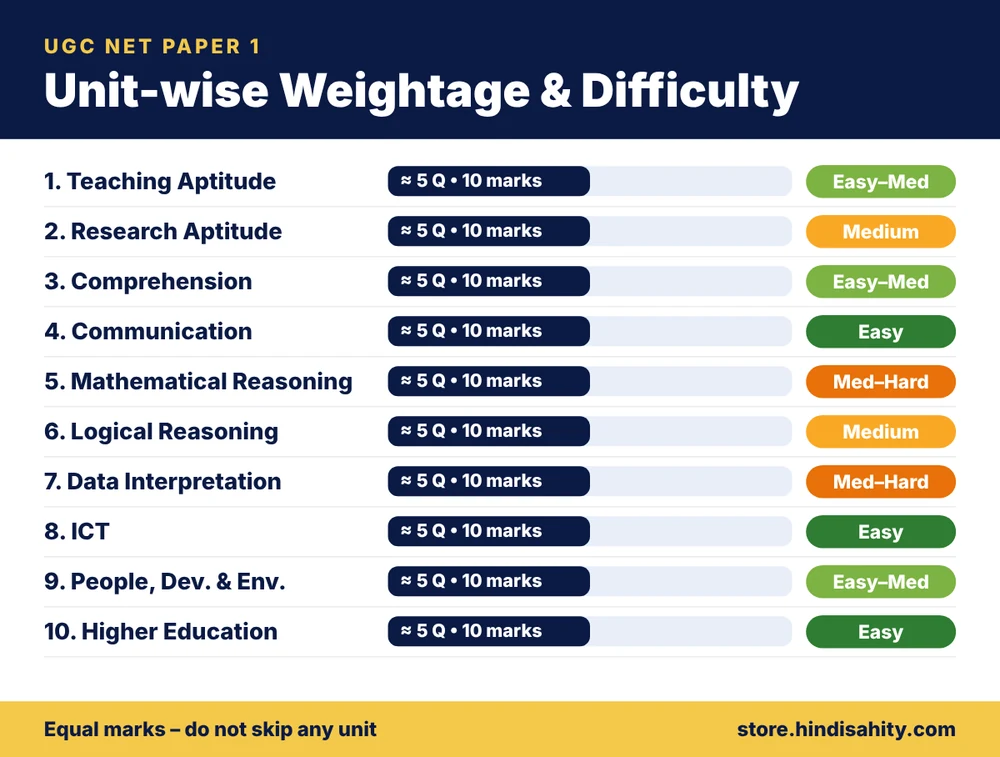
NTA does not fix the number of questions per unit, but the paper usually takes about 5 questions from each unit. Since every unit carries roughly equal marks, no unit should be skipped. What differs is how quickly each unit can be mastered:
| Unit | Nature of questions | Difficulty | Scoring tip |
|---|---|---|---|
| Teaching Aptitude | Concepts, levels, methods, evaluation | Easy–Medium | Learn key terms and their pairs |
| Research Aptitude | Types, steps, sampling, ethics | Medium | Practise statement-based questions |
| Comprehension | 5 questions on one passage | Easy–Medium | Read questions first, then the passage |
| Communication | Types, models, barriers, media | Easy | Remember models with their authors |
| Mathematical Reasoning | Series, coding, percentage, interest | Medium–Hard | Daily 15-minute practice |
| Logical Reasoning | Syllogism, square of opposition, Indian logic | Medium | Use Venn diagrams for every syllogism |
| Data Interpretation | Table/graph-based calculations | Medium–Hard | Master percentage and ratio shortcuts |
| ICT | Abbreviations, Internet, digital initiatives | Easy | Revise abbreviations and initiatives lists |
| People, Development & Environment | SDGs, pollution, agreements, energy | Easy–Medium | Make a timeline of agreements |
| Higher Education System | History, bodies, policies, NEP 2020 | Easy | Revise commissions, bodies and years |
Is the UGC NET Paper 1 Syllabus the Same for All Subjects, JRF and SET?
Yes. The UGC NET Paper 1 syllabus is the same for candidates of every subject, whether you write Paper 2 in English, Hindi, Commerce, Education or any other subject. It is also the same for both outcomes of the exam, JRF and eligibility for Assistant Professor (and PhD admission), because these are decided from the same UGC NET result. State Eligibility Tests (SET/SLET) follow the same 10-unit General Paper pattern, so one preparation covers all of them.
UGC NET Paper 1 Syllabus PDF Download
The official UGC NET Paper 1 syllabus PDF can be downloaded from the NTA UGC NET website (ugcnet.nta.ac.in) under the syllabus section. The official PDF lists only the topics. To see how each topic is explained, with tables, mind maps and practice questions, download our free sample:
📄 Free 20-Page Sample PDF
Contents, Unit 1 notes, a mind map, practice MCQs, diagrams, charts and a mock test page.
How to Prepare the UGC NET Paper 1 Syllabus: Unit-wise Order and 8-Week Plan
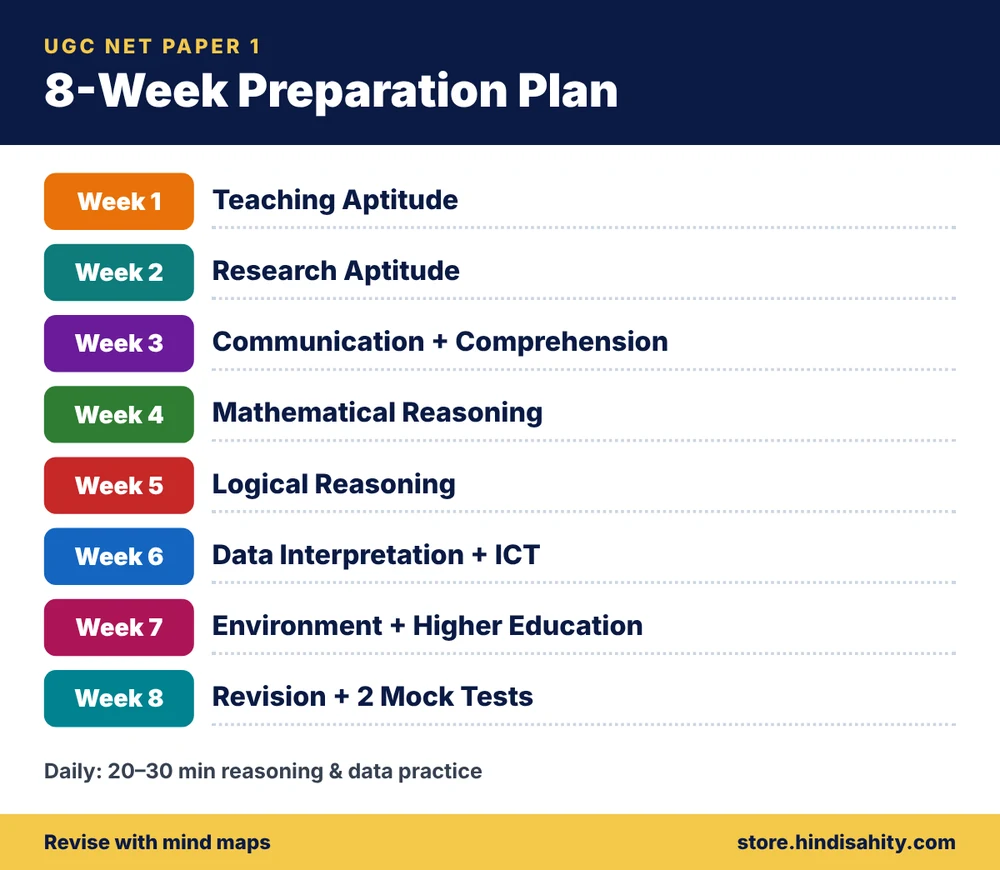
Start with the units that are quick to finish and score well, then move to practice-heavy units. Keep 20–30 minutes daily for Mathematical Reasoning and Data Interpretation from the first week.
| Week | Units to complete | Daily practice |
|---|---|---|
| Week 1 | Teaching Aptitude | 15 min reasoning practice |
| Week 2 | Research Aptitude | 15 min reasoning practice |
| Week 3 | Communication + Comprehension | 2 passages a day |
| Week 4 | Mathematical Reasoning and Aptitude | Series and percentage drills |
| Week 5 | Logical Reasoning | Venn diagrams and syllogisms |
| Week 6 | Data Interpretation + ICT | 1 data set a day |
| Week 7 | People, Development & Environment + Higher Education System | Timelines and lists |
| Week 8 | Full revision with mind maps + mock tests | 2 full mock tests |
- Make one-page notes for every unit and revise them weekly.
- Solve previous-year pattern questions after each unit; statement-based and matching questions are common.
- Attempt full mock tests in the last two weeks within 60 minutes for Paper 1.
- Do not leave any question – there is no negative marking.
UGC NET Paper 1 Syllabus Checklist
Print or save this checklist and tick each unit as you finish notes, practice and revision.
| Unit | Notes done | Practice done | Revision 1 | Revision 2 |
|---|---|---|---|---|
| 1. Teaching Aptitude | ☐ | ☐ | ☐ | ☐ |
| 2. Research Aptitude | ☐ | ☐ | ☐ | ☐ |
| 3. Comprehension | ☐ | ☐ | ☐ | ☐ |
| 4. Communication | ☐ | ☐ | ☐ | ☐ |
| 5. Mathematical Reasoning and Aptitude | ☐ | ☐ | ☐ | ☐ |
| 6. Logical Reasoning | ☐ | ☐ | ☐ | ☐ |
| 7. Data Interpretation | ☐ | ☐ | ☐ | ☐ |
| 8. Information and Communication Technology (ICT) | ☐ | ☐ | ☐ | ☐ |
| 9. People, Development and Environment | ☐ | ☐ | ☐ | ☐ |
| 10. Higher Education System | ☐ | ☐ | ☐ | ☐ |
Practice MCQs Based on the UGC NET Paper 1 Syllabus
Try each question first, then click “View Answer” to check the answer and explanation.
Q1. How many questions are asked in UGC NET Paper 1?
- (A) 40
- (B) 50
- (C) 60
- (D) 100
👉 View Answer
Answer: (B) — Paper 1 has 50 compulsory questions of 2 marks each, i.e. 100 marks in all.
Q2. Consider the following topics:
(A) Levels of teaching
(B) Evaluation in the Choice Based Credit System
(C) Research ethics
(D) Learner’s characteristics
Which of them belong to Unit 1 (Teaching Aptitude)?
- (A) (A) and (C) only
- (B) (A), (B) and (D) only
- (C) (B), (C) and (D) only
- (D) (A), (B), (C) and (D)
👉 View Answer
Answer: (B) — Levels of teaching (A), CBCS evaluation (B) and learner’s characteristics (D) are Unit 1 topics. Research ethics (C) belongs to Unit 2 (Research Aptitude).
Q3. Assertion (A): UGC NET Paper 1 is common for candidates of all subjects.
Reason (R): Paper 1 tests teaching and research aptitude, not knowledge of a particular subject.
- (A) Both (A) and (R) are true, and (R) is the correct explanation of (A)
- (B) Both (A) and (R) are true, but (R) is not the correct explanation of (A)
- (C) (A) is true, but (R) is false
- (D) (A) is false, but (R) is true
👉 View Answer
Answer: (A) — Paper 1 is the General Paper for every subject because it assesses general teaching and research aptitude, reasoning and awareness. So (R) explains (A).
Q4. Match List I (Unit) with List II (Topic):
| List I (Unit) | List II (Topic) |
|---|---|
| A. Research Aptitude | I. Digital initiatives in higher education |
| B. ICT | II. Value education |
| C. People, Development and Environment | III. Styles of referencing |
| D. Higher Education System | IV. International Solar Alliance |
Choose the correct code:
- (A) A–III, B–I, C–IV, D–II
- (B) A–I, B–III, C–II, D–IV
- (C) A–III, B–IV, C–I, D–II
- (D) A–II, B–I, C–IV, D–III
👉 View Answer
Answer: (A) — Referencing styles are part of thesis writing in Research Aptitude (A–III); digital initiatives in higher education are in ICT (B–I); the International Solar Alliance is listed in People, Development and Environment (C–IV); value education is in Higher Education System (D–II).
Q5. Arrange the steps of research in the correct order:
(A) Formulation of hypothesis
(B) Identification of the research problem
(C) Collection and analysis of data
(D) Review of literature
(E) Writing the research report
- (A) (B), (D), (A), (C), (E)
- (B) (D), (B), (A), (C), (E)
- (C) (B), (A), (D), (E), (C)
- (D) (A), (B), (D), (C), (E)
👉 View Answer
Answer: (A) — A researcher first identifies the problem (B), reviews the literature (D), frames the hypothesis (A), collects and analyses data (C) and finally writes the report (E).
Q6. How many marks does each correct answer carry in UGC NET Paper 1?
- (A) 1
- (B) 2
- (C) 3
- (D) 4
👉 View Answer
Answer: (B) — Each correct answer carries 2 marks; 50 questions × 2 = 100 marks.
Q7. What is the total duration of UGC NET Paper 1 and Paper 2 together?
- (A) 2 hours
- (B) 2 hours 30 minutes
- (C) 3 hours
- (D) 3 hours 30 minutes
👉 View Answer
Answer: (C) — Both papers are held in a single 3-hour session without a break, so you can divide the time between Paper 1 and Paper 2 as you like.
Q8. Which of the following is NOT one of the six Pramanas listed in the Logical Reasoning syllabus?
- (A) Arthapatti
- (B) Anupalabdhi
- (C) Upamana
- (D) Smriti
👉 View Answer
Answer: (D) — The six Pramanas in the syllabus are Pratyaksha, Anumana, Upamana, Shabda, Arthapatti and Anupalabdhi. Smriti (memory) is not a Pramana in this list.
Q9. Which graphical forms are named in the Data Interpretation syllabus?
(A) Bar chart
(B) Histogram
(C) Pie chart
(D) Gantt chart
- (A) (A) and (B) only
- (B) (A), (B) and (C) only
- (C) (B), (C) and (D) only
- (D) (A), (B), (C) and (D)
👉 View Answer
Answer: (B) — The syllabus names bar chart, histogram, pie chart, table chart and line chart. A Gantt chart is not listed.
Q10. Statement I: Unit 3 (Comprehension) asks questions based on a passage given in the paper.
Statement II: Comprehension questions require subject-specific knowledge from outside the passage.
- (A) Both Statement I and Statement II are true
- (B) Both Statement I and Statement II are false
- (C) Statement I is true, but Statement II is false
- (D) Statement I is false, but Statement II is true
👉 View Answer
Answer: (C) — Comprehension questions are answered from the passage itself (Statement I is true). Outside subject knowledge is not needed, so Statement II is false.
Q11. Which international agreement in the Paper 1 syllabus deals with substances that deplete the ozone layer?
- (A) Kyoto Protocol
- (B) Montreal Protocol
- (C) Paris Agreement
- (D) Rio Summit
👉 View Answer
Answer: (B) — The Montreal Protocol (1987) phases out ozone-depleting substances such as CFCs.
Q12. Arrange the following in chronological order:
(A) Paris Agreement
(B) Montreal Protocol
(C) Kyoto Protocol
(D) Rio Summit
- (A) (B), (D), (C), (A)
- (B) (D), (B), (C), (A)
- (C) (B), (C), (D), (A)
- (D) (D), (C), (B), (A)
👉 View Answer
Answer: (A) — Montreal Protocol (1987) → Rio Summit (1992) → Kyoto Protocol (1997) → Paris Agreement (2015).
Q13. “Barriers to effective communication” is a topic of which unit?
- (A) Teaching Aptitude
- (B) Communication
- (C) Logical Reasoning
- (D) ICT
👉 View Answer
Answer: (B) — It is listed in Unit 4 – Communication, together with types of communication, classroom communication and mass media.
Q14. Consider the following statements about UGC NET Paper 1:
(A) It has 10 units.
(B) There is negative marking of 1 mark for every wrong answer.
(C) The same Paper 1 is written by candidates of all subjects.
(D) About 5 questions are usually asked from each unit.
Which statements are correct?
- (A) (A) and (B) only
- (B) (A), (C) and (D) only
- (C) (B), (C) and (D) only
- (D) (A), (B), (C) and (D)
👉 View Answer
Answer: (B) — Statements (A), (C) and (D) are correct. (B) is wrong because there is no negative marking in UGC NET.
Q15. Which unit of Paper 1 includes “Oriental, conventional and non-conventional learning programmes in India”?
- (A) Teaching Aptitude
- (B) Research Aptitude
- (C) People, Development and Environment
- (D) Higher Education System
👉 View Answer
Answer: (D) — This topic is part of Unit 10 – Higher Education System.
Q16. For which mode of learning are SWAYAM, SWAYAM Prabha and MOOCs mentioned in the Teaching Aptitude syllabus?
- (A) Offline methods of teaching
- (B) Online methods of teaching
- (C) Traditional evaluation
- (D) Classroom communication
👉 View Answer
Answer: (B) — The syllabus compares offline and online methods, giving SWAYAM, SWAYAM Prabha and MOOCs as examples of online learning.
ENGLISH MEDIUM • 229-PAGE PDF
Want 450+ More Questions Like These?
- All 10 units explained in simple English
- Mind maps, tables and solved data sets
- 50-question full-length mock test with answer key
₹399₹99Buy NowFree 20-page sample
Frequently Asked Questions (FAQs) on UGC NET Paper 1 Syllabus
What is the syllabus of UGC NET Paper 1?
UGC NET Paper 1 (General Paper on Teaching and Research Aptitude) has 10 units: Teaching Aptitude, Research Aptitude, Comprehension, Communication, Mathematical Reasoning and Aptitude, Logical Reasoning, Data Interpretation, ICT, People, Development and Environment, and Higher Education System.
What is the UGC NET 1st paper syllabus?
The UGC NET 1st paper (first paper, also written as “paper 1st”) syllabus is the same as the Paper 1 syllabus: the General Paper on Teaching and Research Aptitude with 10 units, from Teaching Aptitude to Higher Education System.
Is UGC NET Paper I the same as Paper 1?
Yes. Paper I, Paper 1, first paper and General Paper are different names for the same compulsory paper of 50 questions and 100 marks.
Is the UGC NET Paper 1 syllabus the same for all subjects?
Yes. Paper 1 is common for candidates of every subject. Only Paper 2 changes according to the subject you choose.
Has the UGC NET Paper 1 syllabus changed for 2026?
No. The 10-unit Paper 1 syllabus followed by NTA has not changed for the 2026 cycles. Always confirm with the information bulletin on the official NTA website.
How many questions come from each unit of UGC NET Paper 1?
The syllabus does not fix a number, but usually about 5 questions are asked from each of the 10 units, i.e. about 10 marks per unit.
Is there negative marking in UGC NET Paper 1?
No. There is no negative marking. Each correct answer carries 2 marks, so attempt every question.
Is the Paper 1 syllabus the same for UGC NET, JRF and SET?
Yes. JRF is awarded on the basis of the same UGC NET exam, so the Paper 1 syllabus is identical. State Eligibility Tests (SET/SLET) also follow the same 10-unit General Paper pattern.
Where can I download the UGC NET Paper 1 syllabus PDF?
The official syllabus PDF is available on the NTA UGC NET website (ugcnet.nta.ac.in). For detailed unit-wise notes, you can also download our free 20-page sample PDF from this page.
Which units of UGC NET Paper 1 are the most scoring?
Teaching Aptitude, Communication, ICT and Higher Education System are usually considered the most scoring because they are concept- and fact-based. Data Interpretation and Mathematical Reasoning become scoring with regular practice.
Conclusion
The UGC NET Paper 1 syllabus is short, fixed and the same for every candidate, which makes it the most reliable place to gain marks. Finish the quick units first, practise reasoning and data interpretation every day, revise with mind maps and take full mock tests before the exam. Follow the unit-wise syllabus and the 8-week plan above, and Paper 1 can become your strongest paper.
ENGLISH MEDIUM • 229-PAGE PDF
UGC NET Paper 1 Notes PDF in English
- 229-page complete study material for NET / JRF / SET
- Instant download after payment

ABOUT THE AUTHOR
Keval Krishan Ghorela
M.A., B.Ed. (NET Hindi), College Lecturer, Sri Ganganagar (Rajasthan). He runs the Hindi Sahity Channel and prepares exam-focused notes for UGC NET, JRF and other teaching exams.